LLM-powered product features
Assistants, copilots, summarisation, rewriting and guided workflows embedded in web and mobile products.
AI & LLM Development
AI and LLM development that turns language models, retrieval and automation into reliable product capabilities, grounded in your data, designed for users and ready for production.

We've worked with













Overview
Most teams do not need another chatbot demo. They need AI that answers accurately, speeds up operations or unlocks a product experience competitors cannot copy with a prompt alone. Our AI and LLM development service focuses on features that earn their place in the product: clear jobs, measurable outcomes and interfaces people trust.
We design and build LLM-powered workflows across assistants, search, content generation, classification, extraction and agent-style automation. That includes prompt and system design, retrieval-augmented generation (RAG), tool calling, evaluation, guardrails and the product UX that makes the capability feel native, not bolted on.
Whether you are adding intelligence to an existing app or launching an AI-first product, we partner as senior product engineers: pragmatic model choices, secure data handling and a path from prototype to something you can operate in production.
AI features scoped to a clear user or business outcome
Grounded answers with retrieval over your own knowledge and data
Production patterns for latency, cost, safety and observability
UX designed so people understand what the AI can and cannot do
Foundations you can evaluate, iterate and extend after launch
Get in touch
A few details are enough for us to give you a price. We'll get back to you within one business day.
What we provide
From first prototype to production-grade intelligence inside your product.
Assistants, copilots, summarisation, rewriting and guided workflows embedded in web and mobile products.
Retrieval over docs, tickets, policies and product data so answers stay grounded in what your business actually knows.
Models that take structured actions such as looking up records, triggering workflows, and drafting then confirming, with clear human control points.
Classify, extract and transform unstructured content into reliable data your systems can act on.
Test sets, quality checks, fallbacks and safety boundaries so behaviour stays predictable as you iterate.
Pragmatic choices across providers and open models, with APIs, auth, cost controls and monitoring built in.
Selected work
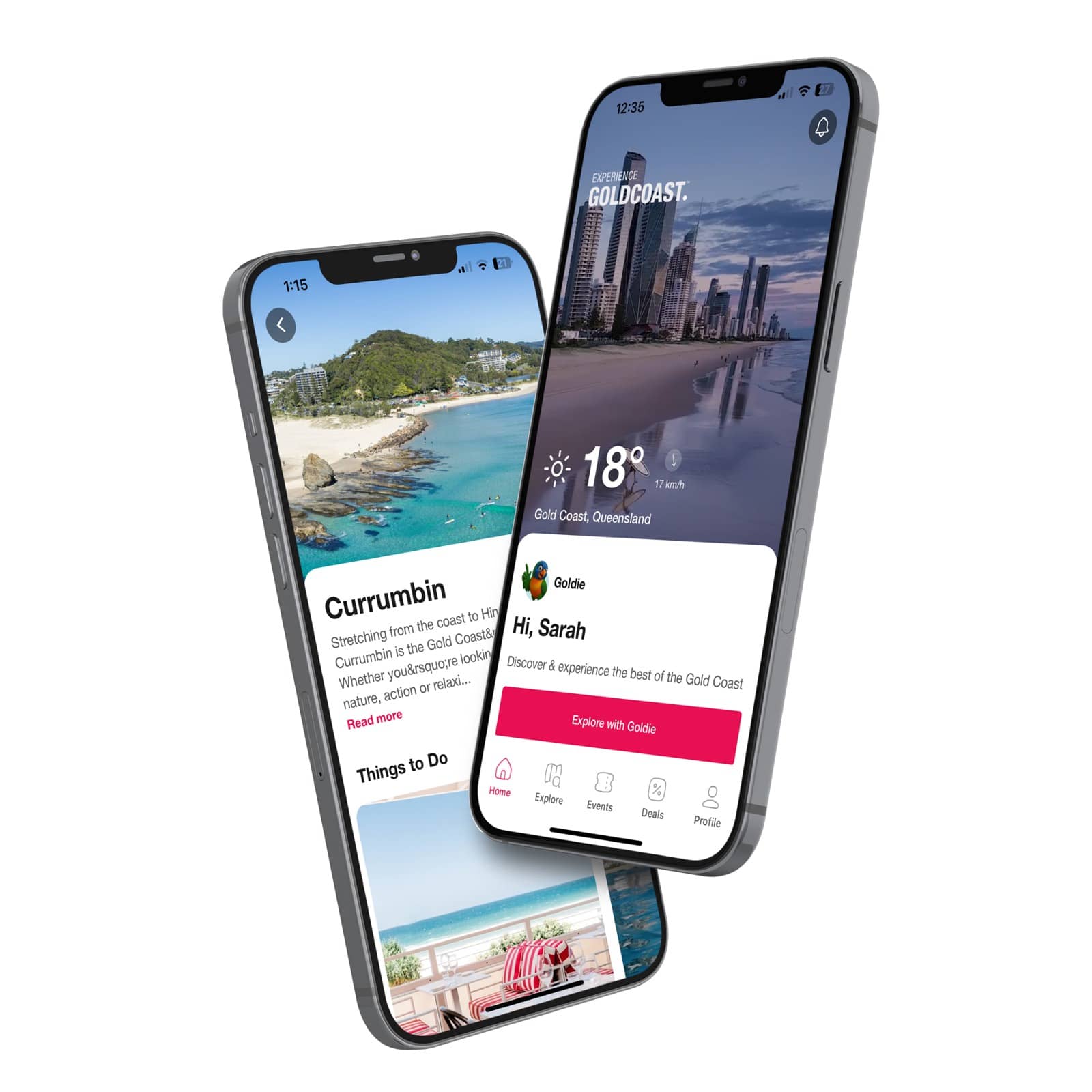
Redefining how locals and visitors discover the Gold Coast.
View project →Our approach
Outcome first, then architecture, so you do not scale a clever demo that fails with real users.
Clarify the user, the decision or task, success metrics and where AI genuinely beats a simpler rule-based approach.
Build a thin slice against representative content and edge cases. Validate quality, latency and UX before wider investment.
Add retrieval, tools, evaluation, logging, rate limits and failure modes. Ship behind product surfaces people can trust.
Instrument quality and cost, gather feedback and iterate prompts, data and workflows as usage grows.
Who it's for
When language, unstructured data or repetitive knowledge work is the bottleneck, well-built AI becomes a product advantage.
Assistants that resolve common questions with grounded answers, and escalate cleanly when they should not guess.
Tools that help teams draft, search, summarise and action work across policies, CRM notes and operational docs.
Search and Q&A over large document sets for education, professional services, healthcare ops and similar domains.
Generate, transform and route content with human review where quality or compliance demands it.
Why Spritely
We ship AI as product craft, not as a science experiment parked next to your roadmap.
We start from the user journey and business outcome, then choose models and architecture that serve that job.
Where accuracy matters, we design retrieval, citations and fallbacks so the system is useful when it knows and honest when it does not.
UX, APIs, data pipelines and model orchestration stay in one team, with fewer handoffs and fewer brittle demos.
Logging, evaluation and iteration loops are part of delivery, so quality can improve with real usage.
Google rating
Get in touch and we will map the AI or LLM capability worth building, and a practical path from prototype to production.
FAQ
Still deciding on scope or stack? Get in touch →
Typically: problem framing, UX for the AI surface, prompt/system design, model integration, retrieval or tools where needed, evaluation, security considerations and production deployment. Scope is defined around the feature you need to ship, not a generic “AI project.”
We start with the simplest approach that hits quality targets, often a strong hosted model plus good retrieval and prompts. Fine-tuning or specialised models come in when evaluation shows they are worth the cost and complexity.
Yes. We design data flows with least-privilege access, clear retention boundaries and provider choices that match your security requirements. Private knowledge stays in retrieval pipelines you control rather than being casually pasted into prompts.
Through grounding (RAG), constrained outputs, tool use for facts that should be looked up, evaluation against real examples and UX that shows uncertainty or sources. No stack eliminates risk entirely. Good product design makes failure modes visible and recoverable.
A focused prototype can land in weeks. A production feature with retrieval, evaluation and polished UX usually takes longer and should ship in phases. Discovery clarifies data readiness and risk before estimates firm up.
Absolutely. Most engagements extend current web or mobile apps with a new AI capability such as assistant, search, automation or extraction, rather than rebuilding everything from scratch.
We are provider-pragmatic: OpenAI, Anthropic, Google and other APIs, plus open models when they fit latency, cost or data constraints. The product requirements drive the choice, not a preferred logo.
More services
Most products need more than one capability. Pair this service with complementary work from the same in-house team.

Native-quality iOS and Android apps with smooth onboarding, payments and offline support.
Explore our mobile app development→
Fast, accessible marketing sites and web experiences engineered to convert.
Explore our website development→
Bespoke internal tools and platforms tailored to how your team works.
Explore our custom software development→
Launch a focused, investor-ready first version in weeks, not months.
Explore our MVP development→
Research-led interfaces and design systems that feel effortless to use.
Explore our UI/UX design services→
Eligibility assessment, documentation and compliant claims that unlock government funding for software R&D.
Explore R&D Tax Incentive applications→